67 posts tagged with "how to"

View All Tags

How to Implement a Canary Release with Feature Flags (Step-by-Step Guide)

· 11 min read

David Herbert
Turning deep tech into stories developers actually want to read.
Csilla Kisfaludi
Tech support by day, movie addict by night, crazy cat lady 24/7.

When shipping new features, releasing them to all users at once can be risky. Even small bugs can affect thousands of users immediately. That's why modern teams rely on canary releases and feature flags to roll out changes gradually, monitor real-world performance, and reduce the risk of failure.

In this guide, you'll learn:

  • What a canary release is
  • How it works with feature flags
  • A step-by-step rollout strategy using ConfigCat
  • Best practices and common mistakes to avoid
Canary release cover cover

Feature Flags in Bun (The New JavaScript Runtime)

· 11 min read
Johnkingsley Amaechi
Working To Make the World Better — With Code.

Bun is making waves in the JavaScript ecosystem. This speedy new toolkit promises faster startup times, native TypeScript support, and improved performance compared to Node.js. But as Bun gains adoption, developers require modern tooling to match its capabilities. Feature flags are one such tool, and are perfect for Bun applications.

Coming up, we'll learn what Bun is and how it compares to Node.js, then dive into using ConfigCat feature flags in Bun projects. Finally, we'll discuss how to safely roll out new features, A/B test them, and quickly fix problems in production, all with the help of feature flags.

Feature Flags in Bun cover

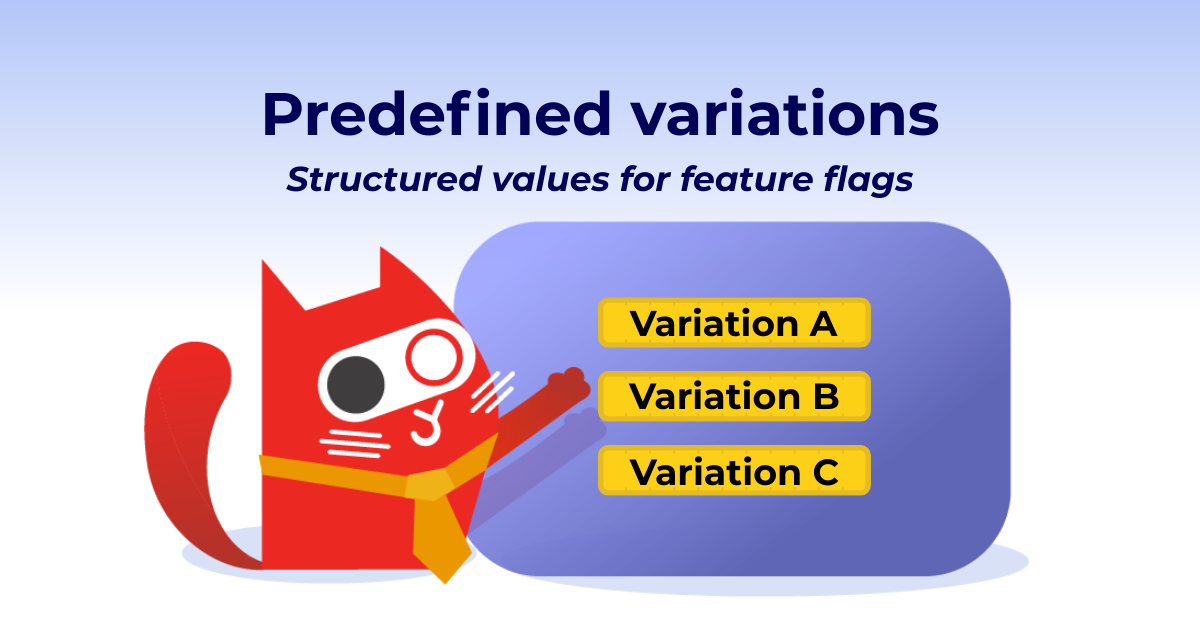
Feature Flag Variations: Structured Values for Multivariate and JSON Workflows

· 4 min read
Csilla Kisfaludi
Tech support by day, movie addict by night, crazy cat lady 24/7.

If you’ve ever wished your feature flag values worked more like enums, this update is for you.

Over the past years, we kept hearing the same request in different forms:

  • “Can we have enum-like values for feature flags?”
  • “Can we avoid people mistyping values?”
  • “Can we define JSON values once and just select it?”
  • “Can we separate flag definitions from rollouts?”

This usually came up when teams started using multivariate feature flags or working with more complex JSON feature flags.

Free-form values are flexible. But when feature flags become operational tools, toggled by Customer Success, Sustainment teams, or junior teammates, flexibility without guardrails becomes a risk.

So we built Predefined variations.

ConfigCat Predefined Variations cover image

Feature Flags in Flutter: Smarter Releases with ConfigCat

· 5 min read
Roxana Halați
I'm pretty cool, but I cry a lot.

Releasing new features in a mobile app can feel like walking a tightrope, especially when updates require going through lengthy App Store and Google Play review processes, and users still need to download the new build. That's where feature flags come in. They are software development tools that give developers the power to toggle features remotely, test new functionality safely, and control rollouts without shipping a new app version.

This guide shows you how to use feature flags in Flutter (Dart) with ConfigCat, focusing on best practices, manual polling, offline support, and real-world examples.

Best practices in Dart (Flutter) cover

How to Integrate Feature Flags in NestJS

· 8 min read
Chavez Harris
Inspiration does exist, but it must find you writing code.

Software development can be challenging, but deploying and managing new features shouldn't be. With feature flags, you can rest assured that your updates and new features are delivered safely with minimal risk. In this guide, I'll show you how to integrate a feature flag into a NestJS application.

How to use feature flags in NestJS cover

How to Dynamically Update User Segments in ConfigCat

· 6 min read
Johnkingsley Amaechi
Working To Make the World Better — With Code.

In modern software development, feature flags are a must-have. They let teams release features gradually, run A/B tests, and control access for different user groups. But there's a common challenge: How do you keep a list of dynamic user segments (like beta testers) always up to date without manually editing the dashboard every time?

To tackle this challenge, I'll show you how to update user segments in ConfigCat dynamically, including examples of setting up and using the ConfigCat's Update Segment API, best practices for managing segment details, and tips for integrating this functionality into your development workflow.

How to Update User Segments Using the Segments API cover

Introducing Our New Rust SDK - Build Faster and Smarter

· 8 min read
Tímea Kopacz
I have approximate knowledge of many things.

Hey, Rustaceans! We developed the Rust SDK in response to a feature request from one of our customers, OneSignal. When we heard about their needs, we rolled up our sleeves and released the Rust SDK two months later. With it, you can manage feature flags like a pro—whether starting a new project or optimizing an existing app. It allows you to toggle features on and off without redeploying your code. That's right—no more redeploys every time your boss changes their mind about a button color!

With ConfigCat's feature flags, you can gradually roll out new features, rigorously test them (in a controlled environment, of course), and make changes on the fly—all directly from your dashboard! Let's dive into why this is a game-changer for your development workflow.

Introducing ConfigCat Rust SDK Cover

How to Conduct an A/B Test in Elixir

· 9 min read
Chavez Harris
Inspiration does exist, but it must find you writing code.

Instead of relying on assumptions to decide which variation of a piece of software is better, you can let your users guide the decision through a controlled experiment. A/B testing involves splitting your user base into separate groups, where each group experiences a unique variation of a product or feature. By measuring the performance of each variation, you can determine which one works better.

To conduct such a test, you need a tool that helps you split your users into groups and display the appropriate variation for each group. Feature flags are an ideal tool for this. Let's walk through the process of conducting such an experiment in an Elixir app.

How to Conduct an A/B Test in Elixir - Cover Image

Using Feature Flags in Unreal Editor Scripts

· 7 min read
Chavez Harris
Inspiration does exist, but it must find you writing code.

Feature flags have equipped software developers to seamlessly roll out and roll back new features with the click of a button.

Due to their design and architecture, feature flags can be adapted and integrated into many languages and frameworks. They can be used with other technologies to enhance or add decoupled functionalities. Using them when scripting and automating your Unreal Engine editor is no exception to this.

Using feature flags with Unreal Engine python API